
 Three or four kilometres from Ephesus, there is a hill, and on the slopes of this hill is a ruined Basilica. This basilica itself lies in the shadow of a fortress.
Throughout so much of history, we build upon that which has gone before, and just as surely, those who come after us, will build upon that which we leave for them. It is my hope that this will be the case anyway
There are many reasons why we choose to work and build where we do, but rarely does it start based on whether what we can build will reach the highest heights, or what they can tower over, or see eye to eye with.
It is certainly true that these ambitions enter into the thought process of many of those who seek to undertake any significant labour, and yet…
Near Ephesus, there is a hill, and on the slopes of this hill is a ruined Basilica and this Basilica, was built atop the ruins of an older Church.
… Before all this, we choose where we build not because of what is ahead of us or above us, but because of what is underneath us and around us- what can support that which we seek to create, what foundation is stable enough to support the height and width of our dreams, our vocations, our homes or our sanctuaries.
Where we choose to begin more often than not tells us much about where we will end.
There are many scriptures that speak of building, some which remind us to build upon rock, others that tell us that wisdom builds and understanding establishes. All of these contain truth.
Near Ephesus, there is a hill, and on the slopes of this hill, in the shadow of a fortress, is a ruined Basilica, and this Basilica itself was built atop the ruins of an older Church. This older Church itself was built atop of a tomb.
These scriptures aren’t contradictory …no undertaking worth doing has only one material in the building. There is almost always stone and steel, glass and timber, cloth and brick. Likewise with those that put these into their order- there are designers and architects, roofers and framers, stonemasons, finishers and landscapers. Each brings vision and skill to their craft that is essential to each stage of the work. You’d be hard pressed to leave out any one craft without sooner or later compromising the integrity of the whole.
The older church that was built on top of a tomb, the tomb was built around an Apostle, the Apostle was himself built around love.
The Apostolic Johannite Church has many symbols which are emblematic of its tradition and work- some of these we share in common with other Christian Churches, some we share in common with our sister Gnostic Churches, but one of the first ones people encounter that is found only in this form here is that of what we’ve come to call the “Triple J”.
 The red trinity-like symbol came with no pre-packed interpretations but has taken on several ways of being seen as our small community continues to grow and learn together. From one perspective, it contains the initials of our community- AJC, these initials themselves being made up of three J’s, each orientated towards a centre to form a triangle or trinity, which in its centre through implication contains a unity. Everybody brings their own interpretation to this Johannite symbol (and for the symbol itself all due goes to Monsignor Stratford).
Asked personally many times how I see the symbol, the three “J’s” always recall for me, Jesus and the Holy Saints John. Seen in an initiatic light, this also forms the first steps of the Johannite tradition- John the Baptist initiates Jesus, and Jesus in turn initiates John the Apostle. The Baptist prepares us, the Christ transforms us, and the Apostle is the example by which we honour, commune and communicate this mystery- through the transformative power and example of Love.
Near Ephesus, there is a hill, and on the slopes of this hill, in the shadow of a fortress, is a ruined Basilica, and this Basilica itself was built atop the ruins of an older Church. This older Church itself was built atop of a tomb. The tomb is the Tomb of St. John the Apostle.
The Apostolic Johannite Church puts forth nine principles which comprise its core, and each of these has as its foundation, the principle of Love. Principles are perennial where pillars eventually fall to to the tide of time. It is upon the foundation of the Beloved Disciple, the Apostle of Fraternal Love, that a Johannite lays both the stones of the path, and the spires of spiritual aspiration.
In time, some of these stones will crack and fade. The spires may also not reach as far as we desire. Such is the nature of all things human- but love- Divine Love- that Love which so moved the Baptist to make straight the way with his bare feet, that moved God himself to incarnate among us and in us eternally, and the love from which the Apostle takes his name of Beloved, is the foundation which enables us to build and begin again, until our own love for one another is as perfect as the love the Divine has for us.
It is this same love we honour, aspire to and seek to emulate when we invoke the progenitor of our tradition.
Near Ephesus, there is a hill, and on the slopes of this hill, in the shadow of a fortress, is a ruined Basilica, and this Basilica itself was built atop the ruins of an older Church. This older Church itself was built atop of a tomb. The tomb is the Tomb of St. John the Apostle. Legend says that he is not dead, but rather only lies sleeping.
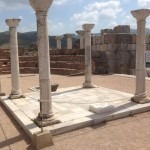 The first basilica was built in the fourth century during the reign of Emperor Theodosius, eventually it would fall into ruin, only to have a new basilica built on the site by the Emperor Justinian almost two hundred years later.
There is a hole at the east-most point of the tomb that leads down into the Tomb. Legend also tells us that when the sleeping Apostle breathes it stirs the dust around his tomb and altar, and that this dust, which is called manna, becomes holy and those who breathe it when it rises up from the tomb, are cured of illness.
Today is the Feast of the Beloved Disciple, the Apostle John, Son of Thunder and Apostle of Fraternal Love, the eternal Sovereign Pontiff and Patriarch and it is him and his love which we must awaken in ourselves, not just by reaching for the heavens but by reaching into the depths of our own being- to the Divine which is incarnated within and among us.
It is this foundation of the love of St. John upon which we choose to build and what we mark on the day of his Feast.
+ IOHANNES IV
Sovereign Pontiff and Patriarch
The Apostolic Johannite Church